Mist Does Not Automatically Make a Lake Photograph Atmospheric
Mist in lake photography can soften edges and hide a subject. Learn when to keep the haze, wait for clearer light, or reframe for a stronger image.
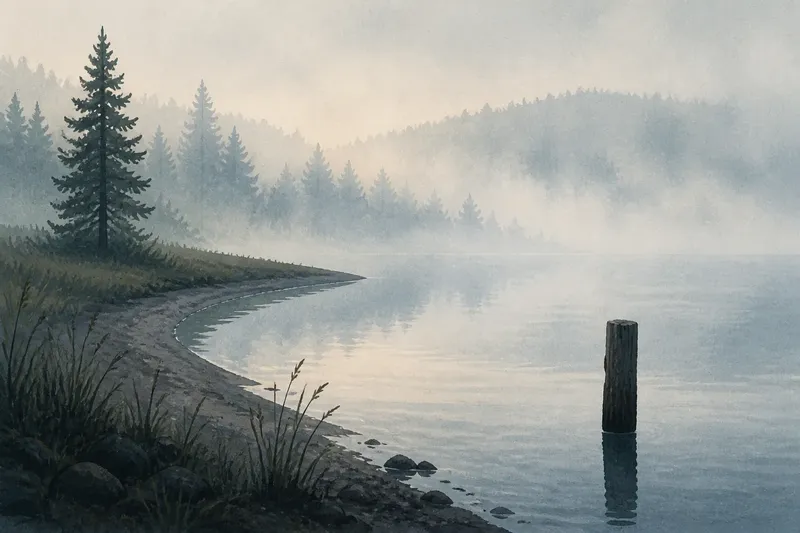
You reach the lake before breakfast, lift your camera, and find the far bank erased by a low veil of mist. Mist in lake photography can turn a familiar view quiet and spare, but it can also remove the very edges and contrasts that give a picture direction. The useful question is not whether mist looks atmospheric. It is whether the scene still gives the viewer something clear to look at.
Three approaches help you decide: work with the mist when it simplifies the view, wait for it to thin when it hides essential forms, or change your framing to make a nearer subject carry the photograph. Each asks for a different kind of scene, and none requires you to treat haze as an effect that automatically improves a frame.
What does the mist leave visible?
Start by looking for what survives the veil. A dark tree, a bright patch of water, a lone dock, or a distinct bend in the shoreline can anchor a pale scene. If nothing stands apart, the frame may lack a focal point even if the atmosphere feels striking in person.
Pay particular attention to edges. Mist lowers the contrast between objects and their backgrounds. A distant ridge may blend into the sky; reeds may merge with a dim bank; a boat may lose its outline against gray water. When the main subject depends on one of those boundaries, the image can feel vague rather than calm.
Look at the view through your camera or phone, not only with your eyes. The screen makes it easier to notice whether the brightest area pulls attention away from the subject, whether a shoreline disappears, and whether open water has become a large, undifferentiated patch. A brief review can reveal a composition that seemed stronger at the water’s edge.
When should you keep the mist?
Keep working in the haze when it removes distractions while leaving a readable subject. A near bank with a clear curve can lead toward a softened line of trees. A dark evergreen against pale mist can hold attention even when distant details fade. The loss of detail then has a purpose: it separates the main forms instead of simply obscuring them.
This approach suits photographers who want a restrained image and are comfortable with fewer visible details. Keep the frame simple. Place one distinct feature where it has room around it, and let the softer background remain background. If several weak shapes compete, move your position or narrow the composition rather than collecting every visible element.
Exposure needs a deliberate look in flat, bright conditions. A camera may render a pale misty scene darker than it appears to your eyes, making the haze look dull or muddy. Check the preview and the brightest areas. If the pale water or sky has lost all visible texture, adjust exposure compensation cautiously and check again; retain enough detail for the bright areas to feel like part of a scene rather than blank patches.
Do not add contrast indiscriminately in editing. Strong contrast can darken the near shore while leaving the mist featureless, and excessive clarity can make the remaining edges look harsh. Use a light touch. The aim is not to remove the atmosphere, but to preserve the subject’s shape and keep tonal transitions believable.
When is it better to wait?
Wait when mist conceals the feature that gives the view its identity. If a small island is your subject but its outline disappears, or a distant shoreline merges with the water, the camera cannot record a boundary that the air has hidden. Give the scene time to change, or move on and return to it later.
This suits photographers whose composition depends on layered distance: a near shore, open water, and a legible far bank. As the mist shifts, check whether those layers separate or collapse together. You do not need to predict when it will clear. Watch for an observable change, such as a dark tree line becoming distinct or a gap opening around a landmark, and decide then whether the frame has gained enough structure.
Waiting is not the same as assuming the scene will improve. Mist may thicken, drift away from the feature you want, or leave the light flatter than before. Set a simple stopping condition before you linger: if the subject’s boundary remains hidden, try another viewpoint or photograph a nearer detail. That keeps the session focused on what the scene is actually offering.
Can a closer frame make the haze work?
Yes, when a nearby subject gives the picture the definition the distant view lacks. Reeds, a wet rock, a dock post, or a strip of textured shoreline can remain sharp enough to guide the eye while mist softens the lake behind it. This is a change of subject, not a way to rescue every obscured vista.
This approach suits anyone willing to trade the broad lake view for a more specific detail. Move along the shore until the near feature has a clean outline against water or pale air. Check the frame edges for cut-off branches, bright debris, or stray structures that pull attention from the subject. If foreground texture becomes a dark mass, include less of it or choose a lighter angle.
Say you arrive hoping to photograph a distant island, but the island’s edge has vanished. A weathered dock post remains distinct beside the water. You could reframe around the post, leave open mist behind it, and expect the resulting picture to read as a near-subject portrait with a soft lake setting—not as a clear record of the island. The change works because the visible subject now carries the frame.
How do you choose between keeping, waiting, and reframing?
Use the scene’s visible structure to choose, not the appeal of mist by itself. Ask what the photograph needs to communicate and whether the current view makes that possible. A few checks can make the decision quick:
- Find the focal point. Can you name the subject in a glance? If not, wait for separation or choose a nearer subject.
- Check the important edges. Is the boundary that defines the subject visible? If it is not, the wide view may not work yet.
- Compare tones. Does the subject differ enough from its background to stand apart? If not, adjust your position or simplify the frame.
- Inspect the brightest area. Does pale sky or water dominate without showing useful detail? Reframe to reduce it or review exposure.
- Look for competing shapes. Do reeds, posts, or distant trees create several uncertain focal points? Remove some by changing your angle or framing tighter.
- Decide what you are willing to lose. If the broad view depends on a hidden shoreline, wait; if a close detail interests you, reframe and accept a different picture.
Keep the mist if it simplifies a scene with a clear anchor. Wait if a defining edge is likely to become visible and the wide composition depends on it. Reframe when a closer subject is already distinct and gives the haze a supporting role. If the right choice depends on camera settings or equipment instructions, follow the manufacturer’s guidance.
What should you look for in the finished image?
Review the picture for a clear visual path. The eye should reach the subject without having to guess where the shoreline ends or which gray shape matters. Atmospheric softness can remain across the background, but a useful photograph usually preserves a point of definition somewhere in the frame.
That point does not have to be a sharp distant landmark. It can be a dark edge, a textured rock, a patch of reflected light, or a simple near shape. If the whole image has equal softness and similar tone, the viewer may not know where to stay. A restrained crop or a small tonal adjustment may help, but neither can restore a subject that mist has hidden completely.
For mist in lake photography, choose the approach that matches what the air leaves visible: keep haze around a readable subject, wait when it erases a necessary edge, or build a closer composition around a distinct feature. Before packing up, make one last frame with a different distance or angle. That small change can show whether the mist is helping this particular picture or merely making the lake harder to read.