Foreground or Open Water: Which Should Lead the Frame?
Choose a lake photo foreground or open water based on what should hold attention, and make a clearer composition without adding distracting detail.
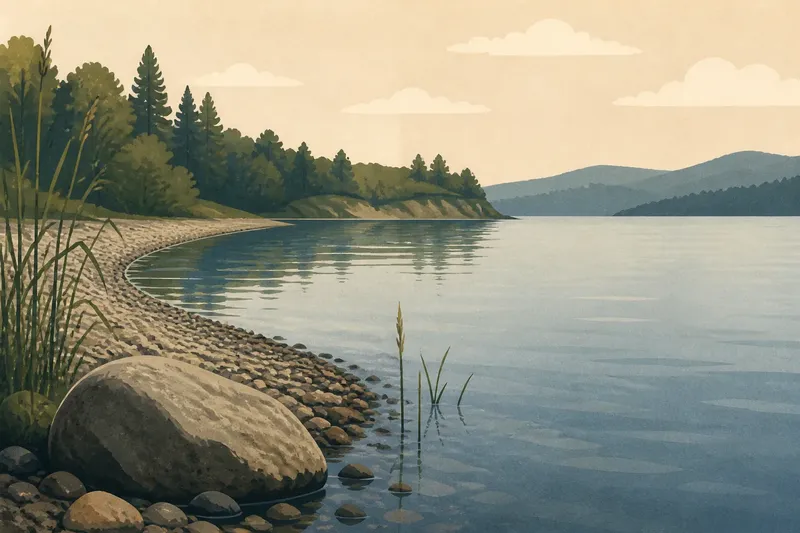
You raise your camera beside a lake and see two possible pictures: reeds and stones close to your feet, or a broad sheet of water with little in front. The choice between foreground or open water sets the frame’s first impression. Pick the near shore when its detail helps explain the place; let water lead when its expanse is the subject.
There is no better option in every situation. A foreground gives the eye a nearby point of entry and can connect the viewer to the shore. Open water removes that close detail, leaving more room for a distant bank, changing light, or a spare arrangement. Decide what you want noticed first, then exclude what competes with it.
When should the near shore lead?
Use a foreground when a specific feature makes the lake feel situated rather than generic. A curved strip of pebbles, a piece of driftwood, or grasses along a small inlet can establish where the camera stands. The feature earns its place if it guides attention toward the water or gives the scene a useful sense of depth.
Look for a shape that connects the lower part of the frame to something farther away. A bank that sweeps toward a headland can lead the eye; a solitary rock can anchor an otherwise broad view. Get low or shift sideways only if that changes the relationship between the near feature and the distant scene. The point is not to collect foreground objects, but to make one do a clear job.
Foreground detail also helps when the far shore is visually weak. If the opposite bank is a thin, indistinct line, textured stones or a recognizable branch can give the composition a strong starting point. Keep the near feature modest enough that it does not become the entire subject by accident.
When does open water deserve the lead?
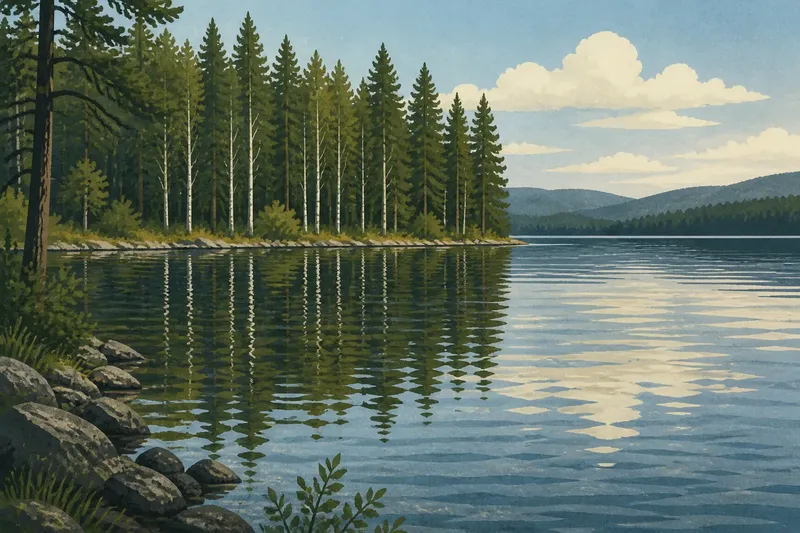
Let open water occupy more of the frame when its surface provides the main visual interest: a clean stretch of color, a broad wake, or a quiet interval between shorelines. A bare expanse can make the scene feel spacious and direct attention to the water’s character. It also avoids giving an unremarkable patch of ground more importance than it deserves.
Choose this approach when the foreground is cluttered, visually heavy, or unrelated to what you want to show. A tangle of branches at the bottom edge can distract from a simple meeting of water and distant hills. Rather than forcing those branches into the picture, raise the camera or step to a clear spot, provided the change does not introduce another obstruction.
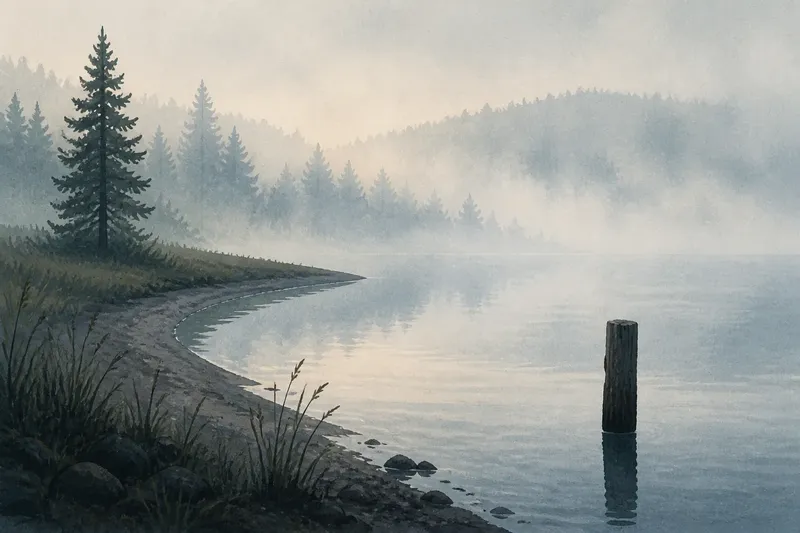
Open water is not automatically a simple composition. A large blank area may leave the viewer with little to follow if the far bank and surface offer no distinct shape. Include a small, purposeful anchor—a buoy, a boat, or a break in the shoreline—when it helps organize the space. Keep it secondary if the water itself should remain dominant.
How do you choose by scene?
- The shoreline has a strong curve: Give it foreground space if the curve carries the eye into the lake. If it points out of the frame instead, try a position where the line leads toward the distant subject.
- The near bank is messy: Favor open water rather than letting stray sticks, litter, or cropped plants crowd the lower edge. A small change in position may remove the clutter without changing the scene’s main idea.
- The far shore is distinctive: Use enough water to separate it from the camera position. A foreground object can help, but only if it does not obscure the outline that makes the far bank worth seeing.
- The water has a striking surface pattern: Give the surface more room. A narrow strip of shore may be enough to establish location; extra foreground can dilute the pattern.
- The scene feels flat: Try a near feature with a clear shape and visible distance between it and the far bank. If every available feature is weak, keep the frame open rather than adding an object just to create depth.
What should the first glance land on?
Check the edges before you settle. A bright stone at the bottom corner, a cut-off branch, or a thin strip of empty bank can pull attention away from the intended subject. Move the frame a little and check whether each edge supports the same visual priority.
Compare two compositions from the same spot: one with more shore, one with more water. On the camera screen, notice which version makes the main subject easiest to identify without explanation. Also check whether the foreground is sharp and prominent enough to compete with the distant subject. If it is, simplify the frame or give that near detail a stronger reason to be there.
Say you are photographing a small cove where a smooth rock sits beside a distinctive bend in the far bank. In one frame, the rock fills the lower corner and hides part of the bend; in another, you shift left so the rock points toward the cove without blocking it. The second arrangement is likely to make both features readable, while a wider view of open water may suit the scene better if the rock adds no useful direction.
Which framing questions come up most often?
How much foreground should a lake photo include?
Include enough to show the near feature’s shape and its relation to the water, but not so much that it takes over unintentionally. If the foreground has no clear role, reduce it or leave it out.
Can a lake photo work without a foreground?
Yes. Open water can carry the composition when its surface, distant boundary, or a small focal element gives the eye somewhere to go. A foreground is optional, not a requirement.
Should the foreground be in focus?
That depends on whether it is a main subject or a supporting shape. If a close object is important, make sure it reads clearly; if it is only a subtle guide, avoid letting its detail overpower the distant view.
What if both the foreground and water are interesting?
Choose which one should be noticed first and frame the other as support. If both demand equal attention, simplify by changing position or narrowing the composition until their roles are distinct.
How can you make the final choice?
Use foreground or open water according to the scene’s strongest useful feature, not according to a rule about how lake photos should look. A near-shore element fits when it gives direction, context, or a convincing sense of distance. An uncluttered expanse fits when the water’s shape or the wider view needs room.
Before taking the picture, name the intended subject in a few words: “curved pebble bank,” “wide blue surface,” or “distant wooded point.” Then remove anything that weakens that choice. This small decision makes the frame easier to read and helps the viewer notice what brought you to the water’s edge.